Scaling robotic automation and saving costs through cloud migration

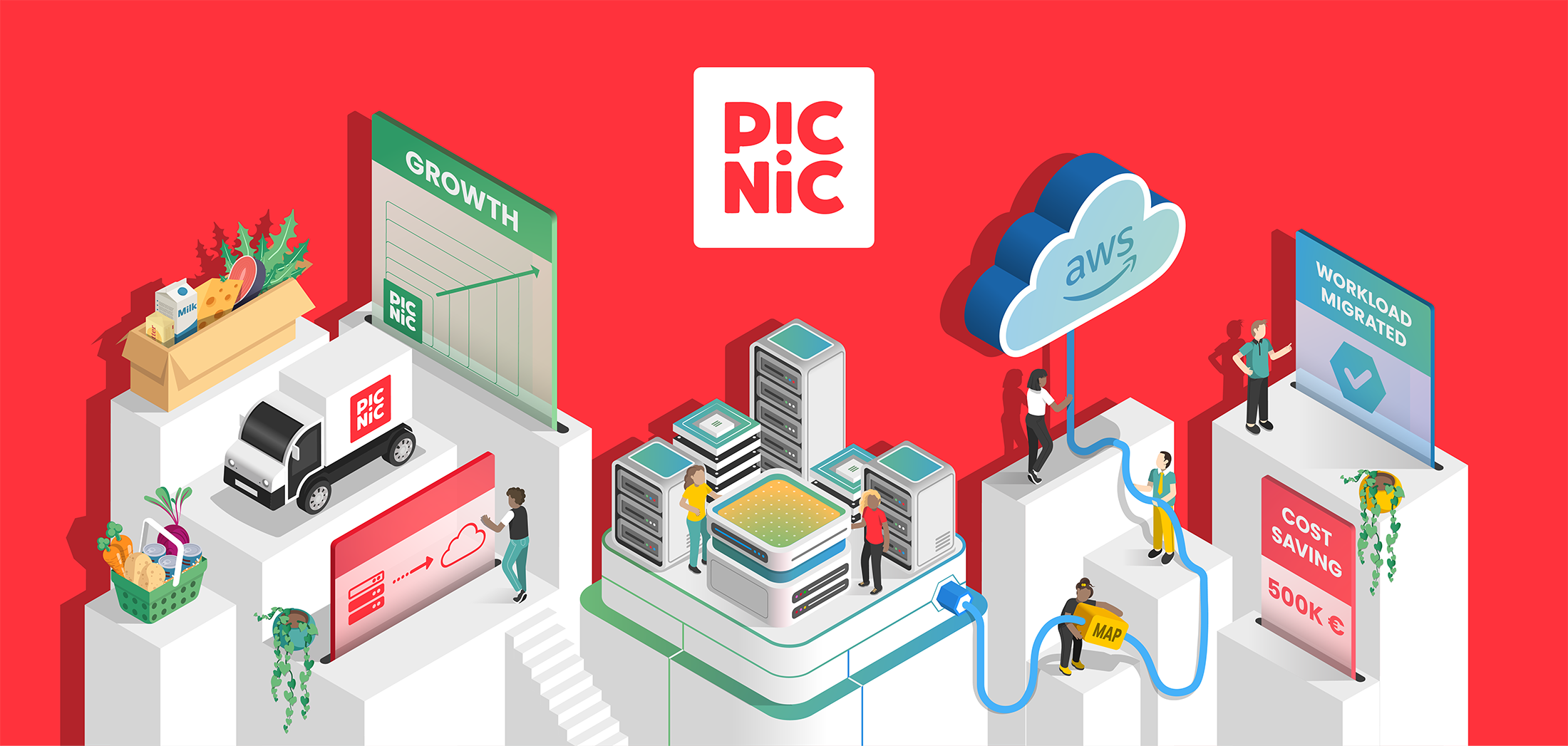
Picnic
Picnic is rethinking the way people buy food. Without physical stores, they use an app-only approach and a user-centric philosophy, to make grocery shopping quick, simple, and fun. Since 2015 Picnic is in hyper-growth expanding in multiple European countries serving 5M customers in 300 cities. With many prestigious awards to their name after raising € 1.4B funding, they have become a true disruptor in some of the most challenging industries: inner-city logistics, e-commerce, e-food retail, and enterprise software.
Key outcomes
We successfully migrated Picnic's real world, latency-critical workloads into the AWS ecosystem, delivering initial savings of €500k over 3 years.
50%
Reduction of monthly infrastructure costs
30%
Reduction of incident costs
60%
Reduction of support effort of on-premise infrastructure

Scaling Picnic's platform for growth while controlling costs
We collaborated with Picnic to enable the growth of their platform by scaling their infrastructure for a rapidly expanding business.
They aimed to harness cloud technologies to scale horizontally and establish new warehouse locations across Europe, free from the constraints of traditional data centres. Operating in a complex organisational environment that couldn’t afford data loss or production downtime, Picnic faced challenges with their latency-sensitive operations.

Migrating Picnic to the cloud
During our 8 month engagement with Picnic, we filled various roles including Solution Lead, Delivery Lead, as well as a dedicated team of engineers and developers to assist them with the transition to AWS public cloud.
Through our expertise in cloud migration projects within complex technical landscapes, we offered the additional capacity Picnic needed to undertake this critical piece of work in a timely manner.
We employed the AWS Migration Acceleration Program (MAP) to tackle the migration of an on-premise data centre to the AWS public cloud. This not only allowed Picnic to diminish their on-premise data centre footprint but also to capitalise on cloud scalability, resilience, and the financial support that AWS provides for such transitions.
Our approach was comprehensive. We began with a Well Architected Review and progressed workload by workload in a pragmatic, Agile fashion. Our focus was on ensuring that the core needs for zero data loss, minimal migration windows, and guaranteed fall-back capability were thoroughly addressed.

Savings and scalability to power Picnic's growth
Our efforts resulted in all workloads being successfully migrated. The warehouse remained fully operational, and customers received their grocery deliveries within the promised timelines.
We not only demonstrated that automated warehouses could operate efficiently with a cloud-based application stack, but we also established a replicable model for Picnic's expansion into new European warehouse builds.
An initial cost saving of €500k over three years was made, with the potential for further savings dependent on the optimisation of the new environment and the scale of new automated warehouse construction. Overall, the project was a success and a testament to our ability to deliver complex cloud migration projects effectively.
AWS, Terraform, Kubernetes, EKS, PostgreSQL, RDS, RabbitMQ, CloudAMQP, Grafana
More successful digital transformation projects delivered by AND Digital
The Range
The Range: rebuilding checkout to grow conversion and revenue
RetailSoftware development & serviceProduct & experience design
Global Art Gallery
Achieving cost savings and SEO improvement with new headless CMS capability
RetailSoftware development & service
Bella & Duke
Increasing customer lifetime value with new digital user experiences
RetailSoftware development & serviceProduct & experience design