The Observer and Tortoise Media unite in one digital platform
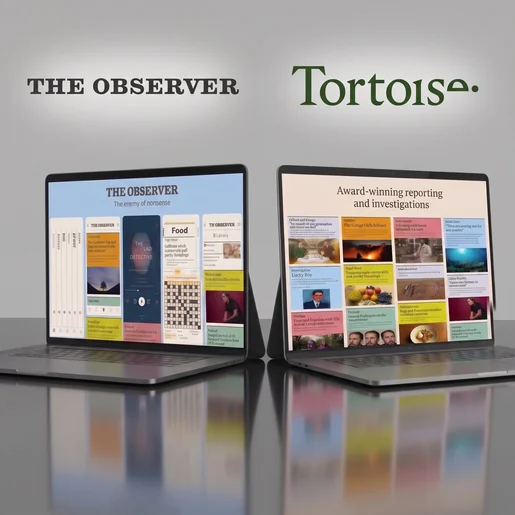
The Observer and Tortoise Media
Founded in 1791, The Observer is the world’s oldest Sunday newspaper; a trusted voice in independent British journalism. Following its acquisition by Tortoise Media in April 2025, The Observer began a new chapter, aiming to "build an Observer fit for the 21st century".
Tortoise Media is built around the principles of slow news and investigative journalism, encouraging readers to spend time understanding the world. The Observer has long played a complementary role as a “second read” newspaper, offering depth, reflection and authority at the end of the week.
The task was to unite these philosophies in a subscription service that carries The Observer's voice and does justice to its journalism.
Key outcomes
The new platform serves as a vehicle to relaunch and grow the newly combined Tortoise/Observer brand, aligned to the needs of today’s reader and listener.
Unified Experience
Consolidated The Observer and Tortoise into a single, coherent digital experience
New Website and App
Delivered a new website, iOS and Android apps using React Native - meaning faster build cycles ongoing through one shared codebase
Scalable Solution
Ensured the solution was scalable to support ongoing editorial commercial and product evolution using a new subscription management platform (Piano)
Bringing two brands with different starting points into one platform
Prior to this project, Tortoise Media had a mobile app with a subscription model focused on audio to support its investigative podcast-led journalism. The Observer had a website that, while functional, was not designed to scale with the ambition of the brand, reflect the Observer’s identity or support a reader revenue-focused business model.
The Observer and Tortoise wanted to create a cohesive, high-end digital experience across platforms that unified their diverse content types such as audio, long form journalism, investigative journalism, puzzles, recipes and events into a single experience.
The platform needed to offer clear, intuitive navigation, a seamless subscription model and reflect their distinct editorial voice. Development took place amid a live rebrand, numerous organisational evolution and multiple types of technology integrations. Due to this, The Observer and Tortoise teams required a stable, commercially viable product that met the needs of editorial, commercial and advertising from day one. Ultimately, within a six month timeline, the project had to bring all elements into harmony
One home for multiple forms of journalism
Clear structure and intuitive navigation
A digital subscription-based model
An AI-Supported Software Delivery Approach
Agents that support continuous enhancements to the service, in a more cost effective way.
Enhance end-to-end software delivery lifecycle
The end-to-end cycle is accelerated using Claude Code from specification, to code, test, build and continuous monitoring
Reduction of manual human tasks
Autonomous agents take over tasks that create toil such as authoring JIRA tickets, writing code and creating design prototypes - freeing the team up for more impactful work
Human control at all times
A human is always accountable for any agent-supported tasks reducing the risk that can otherwise result from non-deterministic AI models
A calm digital experience, true to The Observer
We embedded ourselves alongside The Observer and Tortoise Media teams for the duration of the programme, working day to day from their offices over a six month period. This proximity helped us listen closely to editorial, design and commercial teams to understand the brand’s vision and operational nuances.
Together with The Observer and Tortoise Media’s team, we set out to understand their vision and translate it into a shared idea of the final product delivered. We ran a series of structured workshops with editorial, design, audio and commercial stakeholders to explore how different types of content should behave - how articles should be presented, how long form reads should be experienced, how puzzles should work, how audio should feature within the product. We also defined which capabilities mattered most for launch, surfaced priorities, clarified trade offs and aligned on what would define success.
Design and Brand
The Observer and Tortoise Media were keen to preserve The Observer's visual evolution. This resulted in our signature "Book Spines" concept - a digital navigation device that invokes the tactile joy of leafing through a printed Sunday paper. This approach frames the publication as a curated whole rather than a disconnected feed of articles.
Technology
We used React Native and a shared component library to develop the web, iOS, and Android applications in parallel. This significantly reduced time-to-market while guaranteeing a flawless, consistent user experience.
Our developers used Anthropic’s Claude Code for development and designed an internal agentic platform, accelerating their understanding and delivery within new technologies.
Subscriptions
A non-negotiable, day one priority was subscription revenue. After a rigorous vendor selection process, Piano was selected as the subscription platform and we integrated with them and multiple other vendors to deliver a seamless reader revenue experience.
Data
We engineered a zero-disruption data migration strategy. We carefully ported Tortoise Media’s digital subscribers and integrated The Observer’s legacy print subscribers into a single system. This provided a unified audience view with seamless cross-platform access rules from day one.
Agentic Workflow
Discovery and documentation Agents were deployed to run codebase analyses, API mappings, and infrastructure audits. This process compressed what typically requires weeks of manual discovery into a week. This process continues throughout all workflows to synchronise any changes with documentation.
Agentic migration The team utilised agents to plan, specify, and execute complex infrastructure migrations across environments. AI agents created, validated, and tested configuration pipelines at every step, dropping infrastructure migration time down from weeks to days.
Workflows End-to-end agentic workflows were embedded directly into our process; planning, specification, coding, testing, and monitoring. Leaning on quality engineering practices, we minimised the scale of changes so humans maintain context, whilst refining the ceremonies and identifying areas where AI can improve outcomes.
A Unified, subscription-enabled digital experience for sustainable growth
The new Observer launched on time and within budget across Android, iOS and web, bringing The Observer and Tortoise together into a single, coherent digital experience for the first time since the acquisition.
The product translates a historically print led newspaper into the digital world, creating a quiet, calming space designed for slow, deliberate engagement.
After our agentic stage with Claude Code the AI supported software delivery process has delivered a significant impact to the previous traditional process:
Average Jira tickets delivered per engineer increased from 10 to 22 (+114%).
Average pull requests merged per engineer increased from 11 to 36 (+221%).
Average lines of code added per engineer increased from 2k to 14k (+672%)
Human focus has shifted to delivering high-value outcomes. This improves the end-to-end software delivery cycle, and evolves the product roadmap in line with the broader business strategy.
Success Metrics
On-time launch
The programme launched on time for the Black Friday 2025 commercial window and within budget.
#2 News App
The iOS app reached the #2 UK News App within a week of launch
Featured App
The app was featured in the App Store during Cyber Tuesday
Subscriber Growth
The product delivered significant digital subscriber growth and digital revenue, beating subscriber projections by 18% and, within a short timescale, saw digital subscribers surpass the number of legacy print subscribers built over a much longer period
Reduced Cycle Time
Cycle time reduced from 24 days to 20 days, enabling a 20% quicker time to market, with a smaller team
Following our acquisition of The Observer, we found ourselves at the start line in terms of tech, needing to quickly build production systems for print and digital publishing and consumer products. Working in a highly integrated way with our small internal team, AND stepped up to bring our vision of a bold new identity for The Observer to life across print, web, app, audio and newsletters, innovating with integrated AI development processes, beautiful design and UX improvements like our bookshelf navigation formula. We achieved timelines many thought impossible, launching products in less than six months that our peers have evolved over more than a decade, creating a new reader revenue-focused future for the world's oldest Sunday newspaper. We are seeing subscription growth that's beating our projections, strong downloads (#2 on the App Store in three weeks) and great feedback from readers new and old.
React Native, Next.js, Vercel, Expo, React, TamaGUI, Node, TypeScript, Playwright, Jest, Maestro, Piano, Stripe, Atlassian, Anthropic
More successful digital transformation projects delivered by AND Digital
SSP
SSP and Sigma: building real-time insight from 40 million rows
Hospitality & LeisureData platforms & productAI, intelligent systems & agentic operations
IAG Loyalty
Modernising the Avios mobile app without breaking delivery
Hospitality & LeisureSoftware development & service
IAG Loyalty
Using technology and data to boost the Avios loyalty programme
Hospitality & LeisureSoftware development & serviceData platforms & product