Enabling genetic sequencing using an AI-driven, web-based app
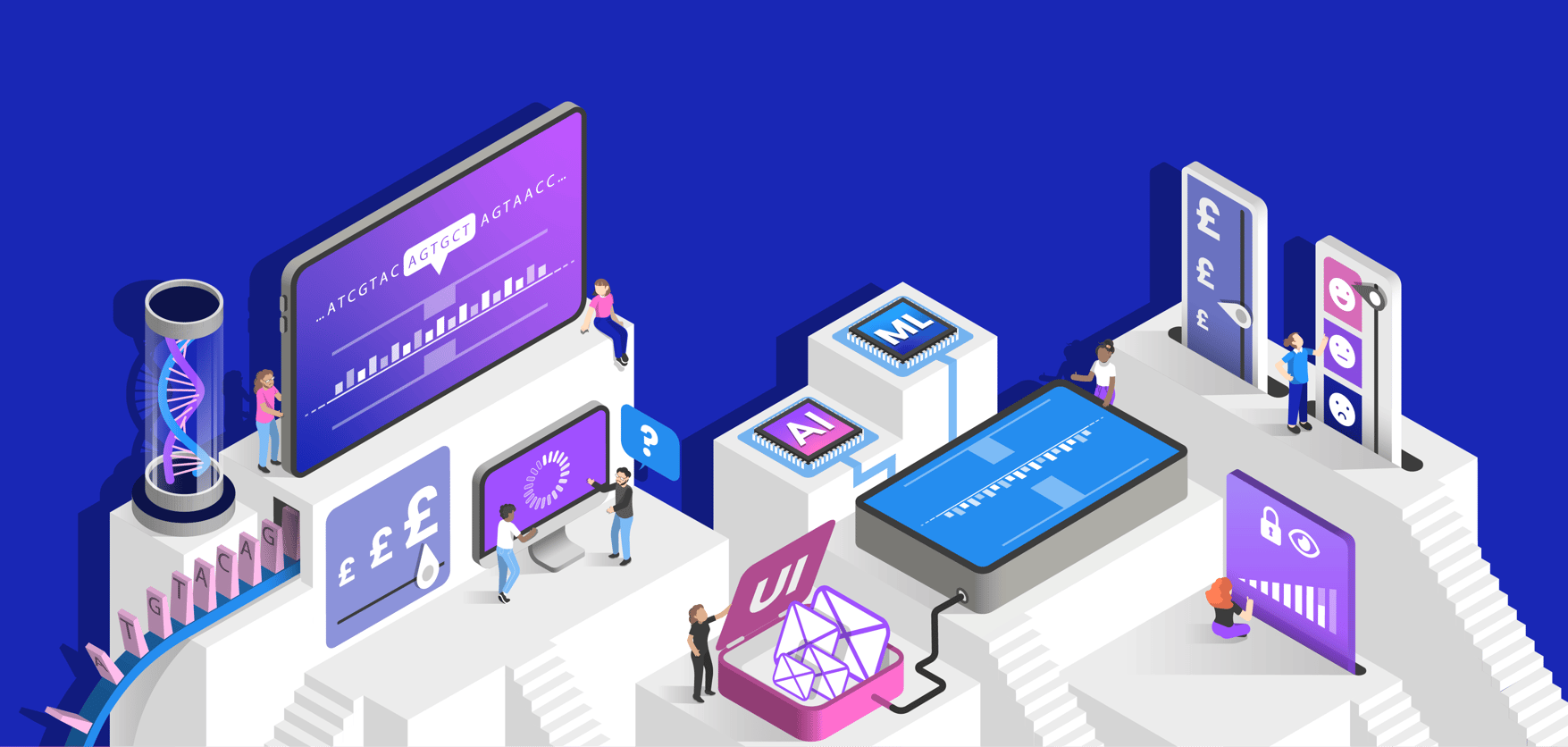
Leading biotechnology company
Our client is a market-leading biotechnology company headquartered in the UK that sells to more than 100 markets across the globe. They have a proven track record of delivering disruptive technologies to the markets that they serve and are focused on automation and increasing ease of use through the provision of more cost effective solutions and an increasing number of products that can be used without internet connectivity. Our clients’ technologies are used by research scientists worldwide as well as to support ‘real-life’ decision making in healthcare, industry and other applied settings.
Key outcomes
We helped a leading biotechnology company to build a new browser-based DNA sequencing application through the use of AI. Working together, we designed and built a solution that has significantly improved customer experience and data privacy whilst simultaneously reducing costs.
1.1 million
DNA sequencing samples per second achieved on a consumer-grade MacBook Pro.
97% - 99.8%
Accuracy of machine learning models, depending on the model chosen by the user.
Improved
Customer experience and data privacy significantly, whilst simultaneously reducing costs.
Tooling that was difficult to use and expensive to support
Our client offers DNA sequencing as a product to their customers. Previously, this was provided through the provision of a sequencing device and application which functioned as a basecaller. A basecaller is a software tool that deciphers the building blocks of DNA and RNA strands, providing a confidence rating for each piece of genetic information.
Whilst the outputs of their current basecaller were technically strong, there were several usability aspects that they wished to improve in order to provide a better customer experience. The current application required a high level of technical proficiency to set up correctly. Due to this technicality, many customers had to pay server farms or cloud providers for additional infrastructure on which they could run it. There was a high customer support requirement from our client, incurring significant time and cost, and customers also needed a high-end PC in order to meet the minimum requirements for a very resource intensive process. Lastly, many customers wished to retain sensitive data, which was not possible with the current application.
As a result, our client approached us to help them design and build a browser-based basecaller application using the latest cutting-edge AI machine learning (ML) browser APIs available so that data inference could be performed using both of their established machine learning models.

An AI-driven, web-based app
We worked with the client to design and build a highly performant, AI-driven web-based basecaller that functioned as a standalone app. It features a bespoke user interface (UI) that has been designed to deliver the same feature set and user experience (UX) that their existing customers had come to expect.
In addition, the app features advanced inference error handling - the ability to identify and deal with errors and uncertainties - that works across both of the clients’ existing ML models. As well as advanced analytics and benchmarking functionality that enables the client to observe and understand how well the app is performing and how users are interacting with it.

Improved UX, reduced costs, and increased privacy
The end result of the project has been an AI-powered product that better meets the needs of our clients’ customers. This has been achieved through:
Improved user experience: the user-friendly browser based DNA sequencing app is not only simpler and less resource intensive to use, it’s also simpler for customers to set up by themselves. This has eliminated the need for advanced technical proficiency and high-end hardware, widening the potential customer base for the product.
Reduced costs: the move to a browser-based app means that customers are no longer reliant on outsourced server farms or cloud platform providers, ensuring significant savings on their infrastructure costs. What’s more, our client also reduced their costs in the long-term as the ease of use reduces the requirement for high-levels of customer support.
Increased data privacy: the clients’ customers are now able to retain full control over sensitive data without having to send it to servers controlled by either the client themselves or a third party provider. This has led to increased levels of trust which has helped to make our clients’ product a reliable choice for both new and existing customers.
Python, React, HTML5, ES6, Chart.js, WebGL
More successful digital transformation projects delivered by AND Digital
The Observer and Tortoise Media
The Observer and Tortoise Media unite in one digital platform
Media & PublishingSoftware development & serviceAI, intelligent systems & agentic operations
SSP
SSP and Sigma: building real-time insight from 40 million rows
Hospitality & LeisureData platforms & productAI, intelligent systems & agentic operations
IAG Loyalty
Modernising the Avios mobile app without breaking delivery
Hospitality & LeisureSoftware development & service